
What it is for
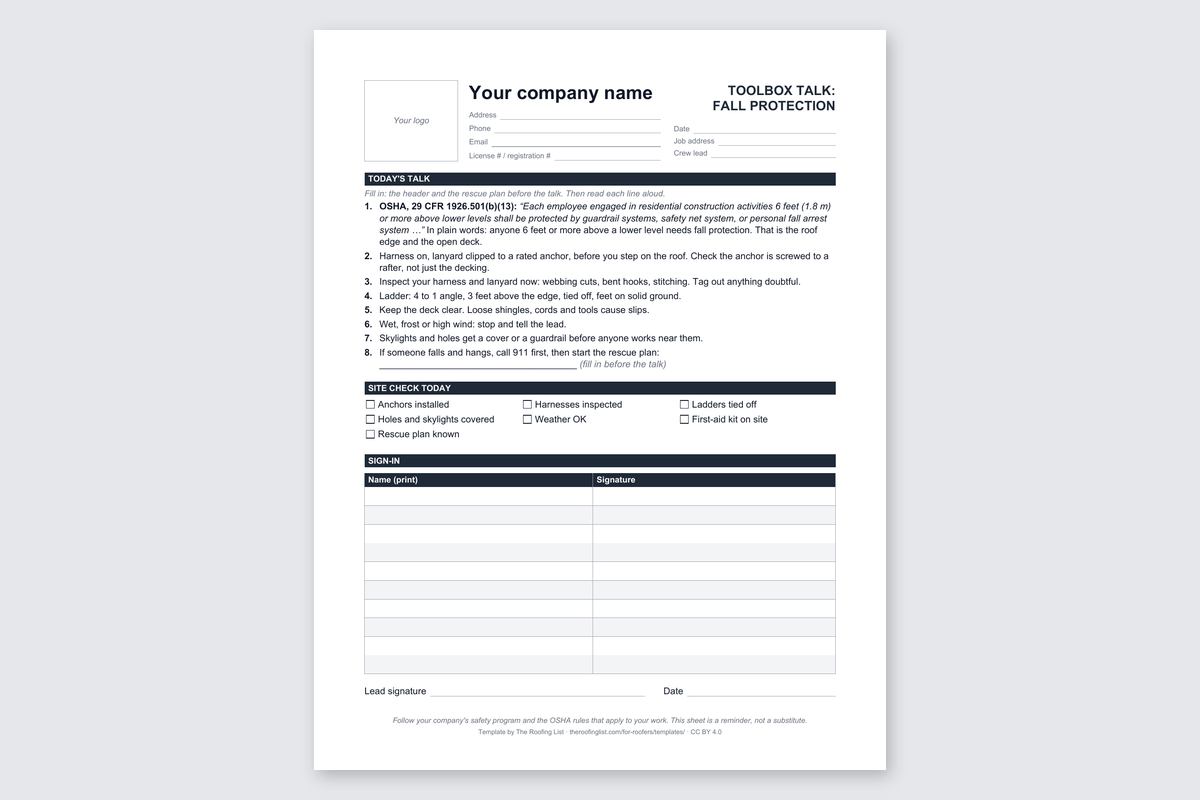
The crew lead reads it aloud on site before work starts. It covers fall protection in eight short points, then a site check and a sign-in table.
Falls are the leading cause of death in roofing. In residential construction, the OSHA rule requires fall protection for work 6 feet or more above a lower level (29 CFR 1926.501(b)(13)).
Follow your company's safety program and the OSHA rules that apply to your work. This sheet is a reminder, not a substitute.
How to use it
- Fill in the date, the job address and the crew lead before the crew arrives.
- Fill in the rescue plan in point 8 before the talk.
- Read the eight points aloud to the whole crew.
- Walk the site and tick the site check: anchors, harnesses, ladders, holes and skylights, weather, first-aid kit and rescue plan.
- Each worker prints their name and signs. The lead signs and dates the sheet.
- Keep the signed sheet with the job file.
What you fill in
- Date, job address and crew lead
- The rescue plan for a worker who falls and hangs
- Site check ticks
- Each worker's printed name and signature
- Lead signature and date
Questions people ask
What is a toolbox talk?
A toolbox talk is a short safety talk the crew lead gives on site, before work starts. It covers one topic, such as fall protection. The crew signs in to show they heard it.
How often should a roofing crew hold one?
The OSHA rule this sheet cites does not set a frequency. Common practice is a talk every morning, or at the start of each new site. Pick a routine and keep to it.
At what height does OSHA require fall protection on a roof?
In residential construction, at 6 feet or more above a lower level (29 CFR 1926.501(b)(13)). The rule names guardrails, safety nets and personal fall arrest systems. Read the OSHA standard for the full text and the exceptions.
Do I have to keep the signed sheets?
Keep them with the job file. A signed sheet shows the training happened and who was there. Follow your company's safety program for how long to keep them.