
What it is for
This file is for you, not the customer. It turns your measurements into an order list, then shows what the job earns after labor and overhead.
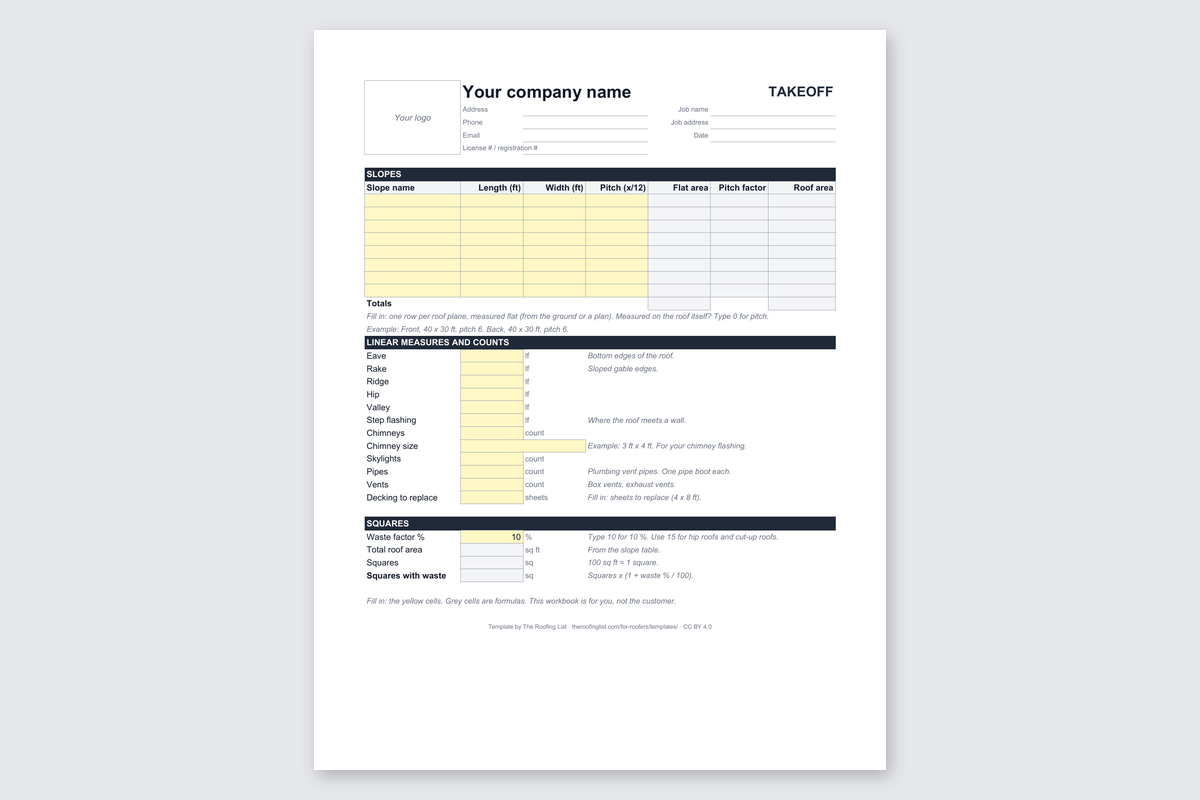
It has three tabs. Measure takes each slope and the edge lengths. Order list works out how much of each material to buy. Job cost adds labor and other costs, and compares the result with your sale price and your target margin.
It uses the same roof math as our roofing estimate template, so the two files agree.
How to use it
- Measure each slope: length, width and pitch. Type one slope per row on the Measure tab. There is room for eight slopes.
- Type the edge lengths and the counts: eave, rake, ridge, hip, valley, step flashing, chimneys, skylights, pipes and vents.
- Set the waste factor. It starts at 10%. Use 15% for hip roofs and cut-up roofs.
- Open the Order list. Check the coverage per unit against your supplier's product, and type your unit costs.
- Open the Job cost tab. Fill in one labor method: crew hours, or a rate per square. Pick that method in the Use cell.
- Type the sale price, your overhead and your target margin. The Profit check cell says OK or Below target.
What you fill in
- Slope name, length, width and pitch for each slope
- Eave, rake, ridge, hip, valley and step flashing lengths
- Chimney, skylight, pipe and vent counts
- Waste factor
- Coverage per unit and unit cost for each material
- Decking sheets to replace
- Crew size, days, hours per day and hourly rate, or a rate per square
- Dumpster, permit, equipment rental, fuel and subcontractor costs
- Warranty reserve and overhead percentages
- Sale price and target margin
Questions people ask
How do you calculate roofing materials?
Work out the area of each slope with its pitch, add the slopes, and divide by 100 to get squares. Add a waste factor. Then divide by the coverage of each product: bundles for shingles, rolls for underlayment, and linear feet for starter, drip edge and ridge cap. Round up to whole units.
How many bundles of shingles per square?
Most 3-tab and architectural shingles take 3 bundles per square. Some heavier lines take 4. Check the coverage on the wrapper, and change it in the file.
How much ice and water shield do I need?
Start with the eave length plus twice the valley length. Add rakes and other areas where your local code or the shingle maker asks for them. Divide by the coverage of one roll and round up.
What profit margin should a roofing job have?
We do not set a number, because your overhead decides it. The file shows gross profit after job costs and net profit after overhead, as an amount and a percent. Type your own target, and the file tells you when a job is below it.
How is this different from the estimate template?
This file is private. It shows your costs and your margin. The roofing estimate template makes the copy you give the customer.